IEO Tech
IEO Science and Technology
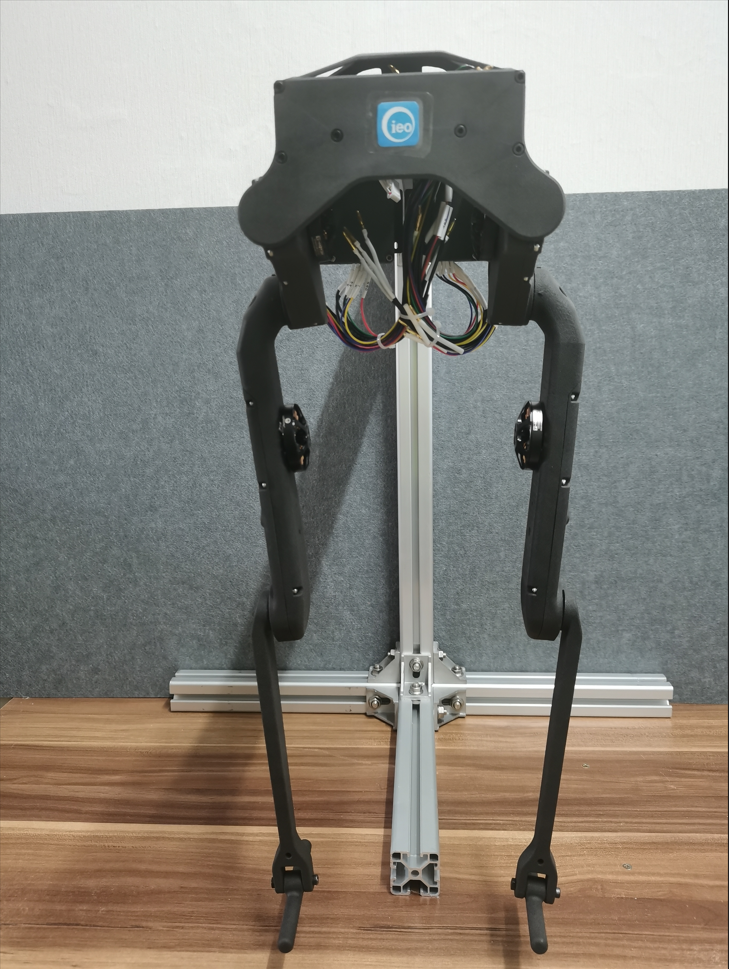
ieoRobot System Introduction
Based on 3D mathematical modeling of bipedal robots, multi-dimensional space manifolds, ordinary differential equations and other theoretical foundations, the ieoRobot humanoid motion control system targets optimal walking energy. Centered on Lagrangian dynamics, it builds a hybrid zero dynamics technology (continuous motion states + discrete motion states) for human-like dynamic walking. Combined with a Kalman-filter prediction algorithm, it has produced a motion control system that lets a bipedal robot walk dynamically and stably over many uneven terrains. Its innovations are:
Innovation 1: Mathematical modeling of human-like bipedal walking, turning it into an understandable, computable and simulatable mathematical form - converting the abstract act of walking into a combination of continuous swinging motion states and discrete impact switching states.
Innovation 2: For different walking environments, optimization computations quickly find the corresponding motion control parameters, enabling the robot to switch walking modes across flat ground, rough ground, slopes and stairs.
Innovation 3: An innovation in control. The ieoRobot walks more like a human in both appearance and behavior, staying stable under many kinds of disturbance, and it performs well in terms of energy loss - so with limited energy the robot can do more and go further. At the same weight and size, dynamic walking consumes only about 30% of the energy of static walking.
ieoRobot Milestones
2015: Project launched - domestic robotics technology research and development of the ZMP bipedal walking control method
2017: Theory put into practice - model derivation and solving of the high-dimensional manifold dimensionality-reduced HZD framework
2018: Implementation and optimization of the HZD underactuated robot motion control system
2019: Overall robot structure design and optimization, control chip selection, and development and refinement of the Linux-based control system
2020: Introduction of the 10-DOF IMU, development of the RIEKF robot posture and velocity prediction algorithm, and algorithm trials on the physical robot
2021: Integration of machine vision input and audio capture, and tuning of the control algorithm
2022: Optimization of the ieoRobot motion control system
Contact for a trial of the robot motion system: hzf@ieeoo.com